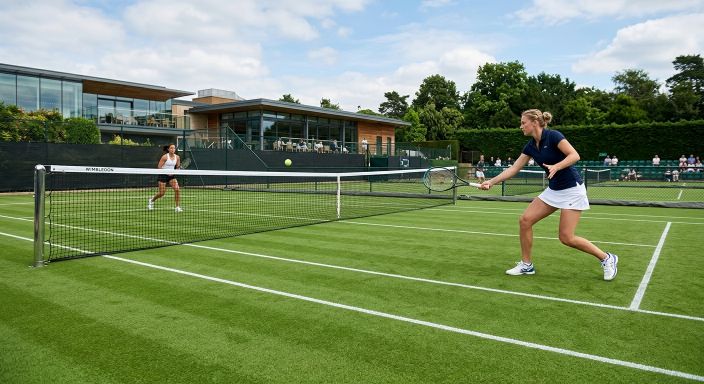
Why Choose Artificial Grass for Tennis Courts in Birmingham
West Midlands rainfall tests every outdoor surface. Clay becomes sticky. Macadam turns slippery when moss takes hold. Natural grass needs constant attention and still closes after prolonged wet periods. Artificial grass handles these conditions better.
Fast Drainage & True Bounce
Water passes through the carpet and porous base quickly. Players return to the court sooner. Bounce stays true. The surface does not crack under frost or bake hard in summer sun.
Joint Comfort & Player Preference
Many adult players and juniors prefer the slightly softer feel underfoot compared with hard courts. Falls feel less harsh. Long sessions leave fewer aches — valued by schools and community clubs.
Dramatically Lower Maintenance
No regular watering. No mowing. No frequent moss treatments. A simple brushing routine keeps the fibres upright and the sand evenly spread. Grounds staff free up time for other jobs.
Clubs that switch often report higher usage hours, especially for evening coaching and midweek league matches. Explore related work: commercial installations · school & nursery surfaces.
We Install Across Birmingham & the Wider West Midlands
Private gardens in Harborne and Moseley, club grounds in Sutton Coldfield and Solihull, school sites near Edgbaston — the same focus applies every time. The surface must perform under regular use and stand up to local conditions.
Our systems follow Lawn Tennis Association guidance and deliver the medium-pace characteristics most clubs and private players prefer. Reliable grip, reduced joint impact and a court that stays open after rain.
Comparison of Common Tennis Court Surfaces in the West Midlands
Local clubs already run artificial grass courts successfully when the right system is chosen and installed correctly.
| Factor | Artificial Grass | Macadam Hard Court | Artificial Clay | Natural Grass |
|---|---|---|---|---|
| Play after heavy rain | Usually possible within hours | Often delayed by surface water | Better than natural but still limited | Frequently closed |
| Joint impact | Lower | Higher | Medium | Lowest |
| Routine maintenance | Brushing and debris clearance | Moss control, crack repair, sweeping | Infill management and rolling | Mowing, watering, fertilising, repair |
| Typical lifespan | 8–15 years with basic care | 10–15 years before major work | 8–12 years | Continuous input required |
| Ball bounce consistency | Reliable medium pace | Fast and firm | Slower with controlled slide | Variable with weather and wear |
| Appearance over time | Stays green and tidy | Can fade and mark | Needs regular attention | Changes with seasons |
| Long-term cost profile | Higher initial, lower ongoing | Medium | Higher ongoing | Highest ongoing |
Tennis Court Dimensions and LTA Specifications
A regulation doubles court measures 23.77 metres from baseline to baseline and 10.97 metres wide. Singles width reduces to 8.23 metres. These dimensions come from International Tennis Federation rules and remain fixed for fair play.
Extra space around the lines is essential. The LTA recommends 6.4 metres of run-back behind each baseline and 3.66 metres of side run. For a single enclosed court the preferred total area reaches roughly 36.57 metres by 18.29 metres.
Orientation matters — we aim to reduce low winter sun glare and limit exposure to prevailing south-westerly winds. Sites near the River Rea or in lower-lying parts of Selly Oak need careful attention to levels and drainage falls. Private plots in Four Oaks, Hall Green or Kings Heath often have different constraints from club sites; we work within those limits while still delivering a usable, properly dimensioned court.
Key Dimensions at a Glance
- Doubles court: 23.77 m × 10.97 m
- Singles court: 23.77 m × 8.23 m
- Preferred run-back: 6.4 m
- Preferred side run: 3.66 m
- Ideal enclosed total: ~36.57 m × 18.29 m
Choosing the Right Artificial Grass Turf for Tennis Courts
Tennis demands different characteristics from football or multi-use surfaces. Longer-pile 3G systems designed for football do not produce the right bounce or grip. Short to medium pile, higher density and the correct infill create the playing qualities players expect.
Turf Pile Height (10–15 mm)
Most tennis-grade systems sit between 10 mm and 15 mm. Shorter pile keeps the ball from burying and produces a livelier response. Slightly longer pile adds a touch more cushion underfoot. We select height according to intended use — intensive club coaching, private family play or mixed junior and adult sessions.
Density, Texture & Fibre Type
Dense tufting resists flattening under repeated foot traffic. Polyethylene monofilament yarns hold their shape better than older fibrillated fibres. Higher quality yarns include UV stabilisers so the colour stays consistent through Birmingham summers and the fibres remain flexible in colder months.
Sand-Filled vs Sand-Dressed
Sand-filled carpets use a higher volume of silica sand to lock the fibres upright — firm and predictable, preferred by many clubs. Sand-dressed systems use less sand and feel slightly softer. Both perform well on a proper base; choice depends on preferred feel, usage intensity and maintenance preference.
UV Resistance & Weather Readiness
West Midlands sunlight and temperature swings test every outdoor surface. Quality yarns resist fading and brittleness. The carpet stays flexible through frost and recovers well after heat. Combined with a free-draining base, the court handles the full range of local conditions.
Shock Absorption & Injury Reduction
A well-constructed base and carpet combination reduces peak impact forces. Players notice less stress on knees and ankles during long matches or coaching blocks. Clubs that cater for older members or busy junior programmes particularly value this characteristic.
Grip, Bounce & ITF Pace Rating
Most tennis artificial grass systems fall into the medium pace category. Players get reliable bounce height and enough surface friction for controlled stops and direction changes without excessive abrasion on shoes or skin.
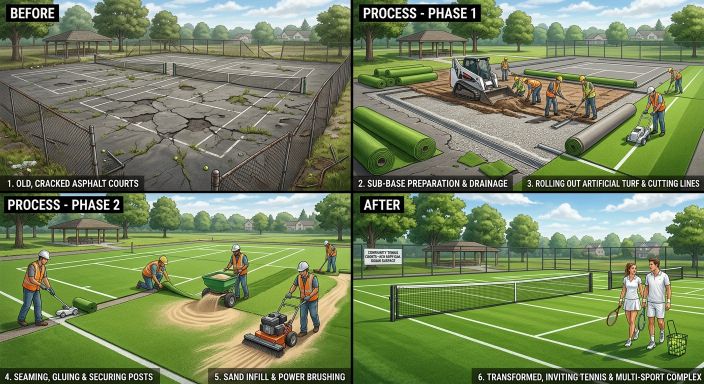
Our Complete Tennis Court Artificial Grass Installation Process
Every successful court starts with thorough preparation. We follow a clear sequence that protects performance for years.
Free Site Assessment & Existing Surface Evaluation
We visit the location and walk the site with you. Levels, existing surface condition, drainage behaviour, access routes and boundary constraints all receive attention. You leave the meeting with practical options and a realistic view of what the site will support.
Groundworks, Excavation & Preparing a Stable Base
Unsuitable material comes out. The formation is shaped to precise falls using laser-guided equipment. Soft spots are replaced. Compaction is checked. A weak base causes most long-term problems, so this stage receives full attention regardless of project size.
Advanced Drainage System Design
Perimeter drains, collector pipes and porous layers work together. Water that falls on the court moves through the carpet and base rather than sitting on the surface. Sites with heavier clay soils or higher water tables receive additional capacity.
Installing the Porous Sub-Base & Shock Pad
A well-compacted porous asphalt or engineered stone base forms the platform. Where extra cushioning improves player comfort, a shock pad is added. The finished base is level, stable and free-draining before any carpet arrives on site.
Laying Premium Synthetic Turf & Sand Infill
The chosen tennis-grade carpet is rolled out, tensioned correctly and joined with strong seams. Sand is brushed in evenly to the specified rate. Even distribution keeps fibres upright and bounce consistent across the whole court.
Precision Line Marking, Nets, Quality Checks & Handover
Lines are applied accurately to regulation dimensions. Nets, posts, anchors and any gates or fencing are fitted. A final full-court brush and inspection complete the installation. You receive a simple care guide covering brushing frequency, debris removal and seasonal checks.
Related services: artificial grass supply & installation · maintenance programmes
Transforming Old or Damaged Tennis Courts
Many projects start with an existing court that no longer performs. Cracked macadam, worn older artificial surfaces or poorly draining clay all appear regularly across Birmingham and the surrounding towns.
Assessing existing surfaces — We test for settlement, cracking, surface breakdown and drainage failure. Honest assessment prevents spending money on a partial solution that will not last.
Resurfacing vs full reconstruction — When the base remains sound, new tennis-grade artificial grass offers a cost-effective upgrade. When drainage has failed or the structure has moved, full reconstruction delivers better long-term results.
A fresh surface transforms how the court looks and feels. Clubs often see increased booking hours once the court becomes reliable again.
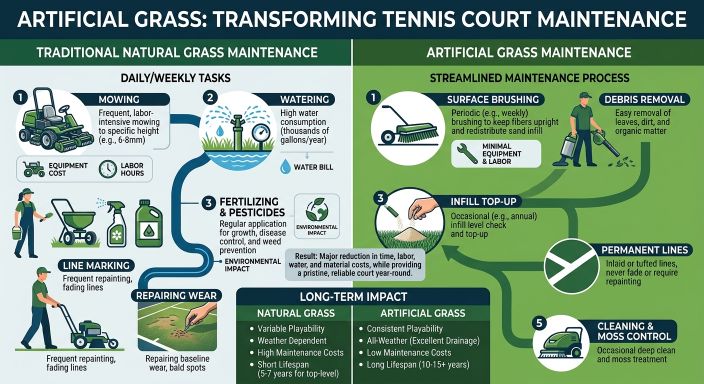
How Artificial Grass Dramatically Improves Tennis Court Maintenance
Traditional surfaces demand regular skilled input. Artificial grass reduces that demand significantly when installed correctly.
Reducing Upkeep & Labour Costs
Grounds teams no longer schedule weekly mowing or watering. Moss and algae treatments become occasional rather than constant. Private owners reclaim weekends previously spent on court care.
Easy Cleaning & Brushing
A tractor-mounted or pedestrian brush keeps fibres upright and redistributes sand. Leaves and debris are cleared with standard tools. Occasional washing removes surface dirt.
Superior Drainage After Rain
Water moves through the system rather than pooling. Courts reopen sooner. Clubs avoid the frustration of cancelled sessions that still occur on neighbouring hard or clay courts.
Minimising Weeds, Moss & Mud
A dense, well-maintained carpet leaves little opportunity for weeds to establish. Proper falls and drainage keep mud off the playing surface.
Consistent Playing Characteristics
Light, regular brushing prevents the sand from migrating and the fibres from laying flat. Bounce and grip stay closer to the original performance for longer.
Extending Court Lifespan
Correct installation and basic care typically deliver 8–15 years of good performance. Predictable sinking fund contributions replace sudden large repair bills.
Simple Seasonal Maintenance Schedule
- Spring: Thorough brush and check sand levels. Top up if needed.
- Summer: Regular light brushing after heavy use.
- Autumn: Prioritise leaf and debris clearance.
- Winter: Keep drains clear and avoid unnecessary traffic when the surface is frozen.
Cost of Tennis Court Artificial Grass in Birmingham
New full-size artificial grass tennis courts generally range from £45,000 to £85,000. The final figure depends on site conditions, access, drainage needs, fencing, lighting and the exact carpet system chosen. Resurfacing an existing sound base usually costs less than a full rebuild.
Key variables that influence price
- Amount of excavation and disposal
- Soil type and drainage requirements
- Choice of carpet and sand specification
- Fencing height, type and gates
- Floodlighting design and installation
- Site access and working space constraints
- Spectator areas or storage
We provide itemised quotes after the free site survey. Many private owners in residential areas and club committees across Solihull and Sutton Coldfield decide the lower ongoing costs justify the initial outlay within a few seasons.
Practical Insights from Local Projects
Sites near existing clubs in Edgbaston and Four Oaks often present different challenges from brand-new private gardens. Established trees can affect shade and leaf fall. Older drainage systems sometimes need upgrading. Access through residential streets requires careful planning of vehicle movements and working hours. We design around these realities rather than forcing a standard solution.
Frequently Asked Questions
How much does an artificial grass tennis court cost in Birmingham?
Do I need planning permission for a tennis court?
How long does the installation take?
What lifespan can I expect?
Is artificial grass suitable for competitive and league play?
What maintenance does the surface need?
Can you resurface an existing court?
How well does the court drain in heavy Birmingham rain?
What about warranties and aftercare?
Areas We Cover Across Birmingham and the West Midlands
We work throughout Birmingham and the surrounding towns. Local knowledge of soil conditions, typical drainage behaviour and planning expectations helps every installation run more smoothly.
Harborne · Moseley · Edgbaston · Selly Oak · Hall Green · Kings Heath · Sutton Coldfield · Four Oaks · Solihull · Wolverhampton · Walsall · Coventry
Ready to Move Forward?
Call us today for a free site survey. We visit your location, assess the practical options and provide a clear written quote. Whether you run a club near the Botanical Gardens, manage school facilities or want a private court at home, we focus on surfaces that perform in Birmingham conditions and stay usable with straightforward care.